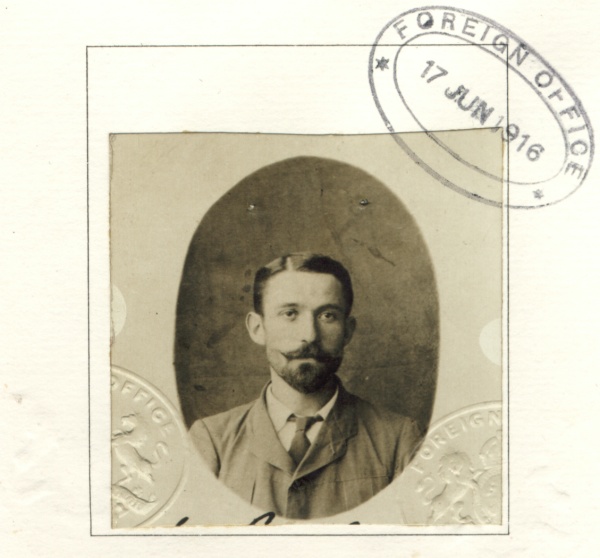
We don’t know if Redmond Barton Cafferata intended enlisting in the forces during the Great War – being married with children and in his 30s he wasn’t in one of the groups most likely to volunteer, and of course there were the demands of the family business. He was, however, involved in the issue of recruiting: In February and March 1916 he was the Chairman of the “Advisory Committee on the Derby Scheme”. As such he found it impossible to get married men to join up. In disgust, he “chucked all up and volunteered my services to the then under sec. of War, Tennant” (1) He was quickly offered a commission in the RNR and Redmond embarked on a career with Military Intelligence. |
|
Prior to 1909 the British Intelligence Service had been a disparate group of organisations, including the Military and Naval Intelligence Departments, but these had been reorganised to meet the perceived threat from German spy networks operating in Britain. The new Secret Service Bureau was initially divided into Military and Naval sections. The Military section was the “Home Department” under the command of Captain Vernon Kell. This eventually evolved into the present day MI5. The Naval section or “Foreign Department” (today’s MI6) was placed under the command of Sir Mansfield Cumming (always signed himself, and was known as, “C”) and was charged with intelligence gathering from abroad. On the outbreak of war, “Cumming’s priorities became military rather than naval”(2) and in January 1916 his organisation was renamed MI 1(c). It joined MI 1(a) – Operations and Planning, and MI 1(b) – Enemy Intelligence relating to troop movements, morale etc. Intelligence summaries from each group were circulated about once a week to interested parties, including the War Office, GHQ and Army headquarters. |
|
There were other benefits too; Pontarlier could provide safety and sanctuary to agents, it allowed instructors to move freely in and around Switzerland without having to establish an official position, could be used as a base for training from England and, of course, allowed close co-operation with the French Commissariat Special de Police. Throughout the autumn of 1916, (and presumably for the rest
of his time in Switzerland) Redmond travelled frequently between
Berne and Pontarlier, staying a few days in each place before
setting off again. On these exchanges he travelled as a “Ministry of
Munitions” representative. |